When Speaking Feels Unsafe in Birth Care
Power, Agency, and the Social Body — A Reflection for Birth Workers
This reflection is for birth workers who care — and are carrying the weight of that care. It is not about doing more, but about widening the lens on power, agency, impact, safety, and presence in birth, so care can remain ethical, embodied, and human.
“Too often, we ask women why they didn’t speak. Rarely do we ask why speaking felt unsafe.”
Within birth care, the phrase “we need women to speak up” is spoken often. I usually hear it from birth workers who care deeply — midwives, nurses, doctors, doulas — people doing their best within systems shaped by protocols, urgency, and risk. It is rarely said with blame. More often, it carries concern, moral weight, and the ache of trying to practise relational care inside environments that do not always support it.
And still, this request holds a complexity, a nuance, that asks to be slowed down.
Birth is not a neutral space. And voice does not arise simply because it is invited.
From the lens of the social body, no woman arrives at birth as an isolated individual. She arrives carrying her history, her relationships, her culture, her spirituality or religion, her previous experiences of care or harm, and her embodied understanding of what happens when she speaks — and what happens when she doesn’t. She arrives already in relationship with power.
In labour, the nervous system, the whole body, reorganises itself to bring life through. This is not a state designed for debate, explanation, or rational advocacy. It is a state of intensity, openness, and deep vulnerability. When we ask a woman in this state to speak up, we are often asking her to access capacities that depend on one essential condition: safety.
When speaking doesn’t happen, the question worth holding is not why didn’t she.
It is whether her body felt safe enough to.
I can share my own experience here.
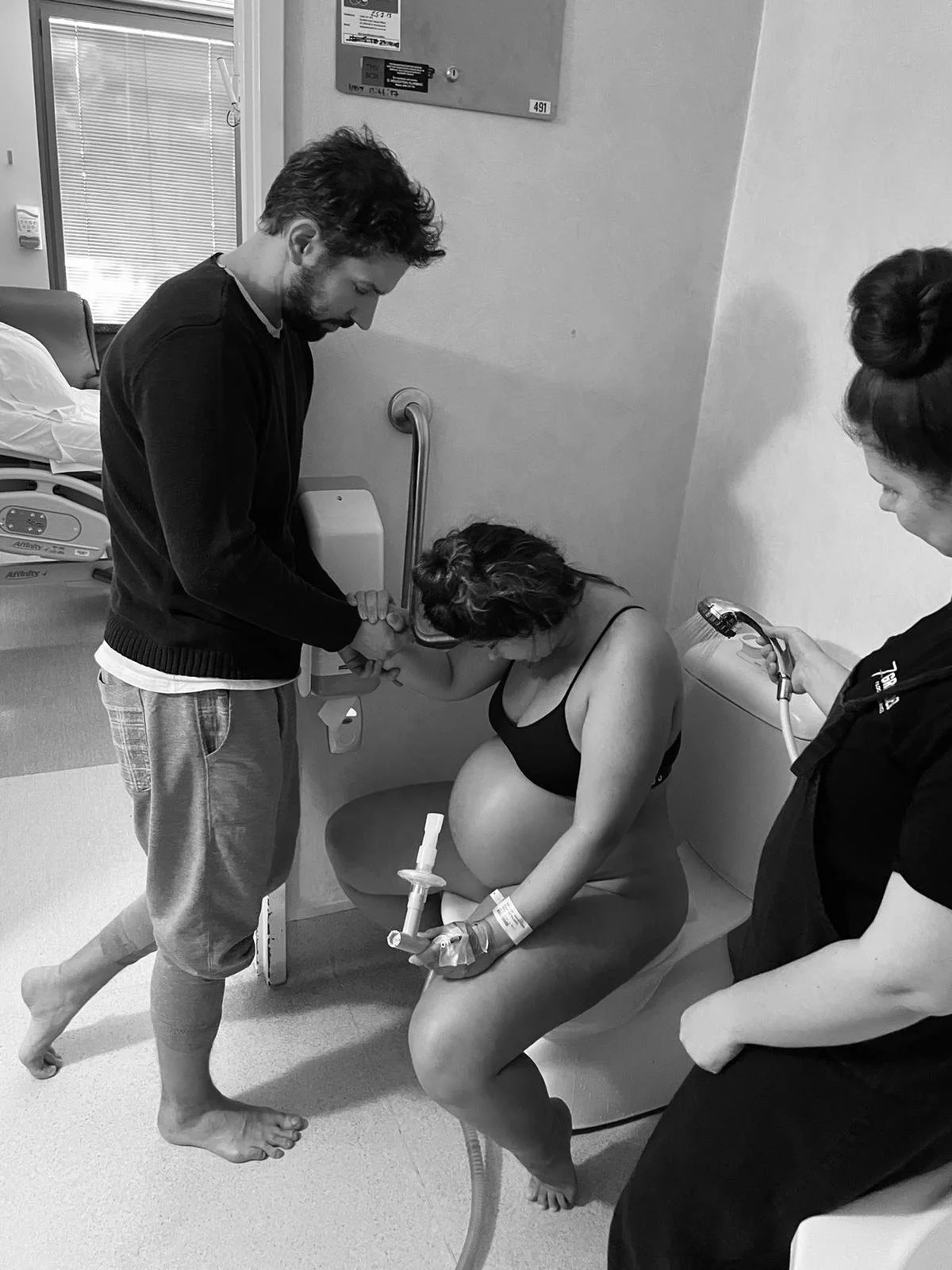
When I transferred to hospital during Kai’s labour, I was offered several interventions intended to speed things up. These offers came repeatedly, often through the middle of surges — moments when my body was entirely occupied with the work of labour itself. I was asked to speak up, to accept or decline, to respond clearly and decisively.
What I remember most is not confusion about what was being offered.
It was constant interruption, and a language that scared me.
My sense of safety kept being shaken.
I remember voicing “I don’t consent” — and yet the asking continued. Each time, something in me tightened. Not because I didn’t know my answer, but because the conditions for being heard were unstable. The timing, the urgency, the repetition — all of it pulled me out of my body’s rhythm and into defence.
From the outside, this could look like choice being offered. From the inside, it felt like my integrity needed to be protected.
This is where power becomes important to name.
Power
Power is always present in birth spaces, whether or not it is acknowledged. Much of it lives quietly in the structures of care themselves. Protocols, time pressure, hierarchies of knowledge, and institutional urgency can create a form of power over — even in rooms filled with care and good intention. Power-over does not require force. It often arrives through interruption, repetition, and the subtle sense that the system’s needs are louder than the body’s signals.
When power-over dominates, a woman’s nervous system may respond by becoming quiet, compliant, agreeable, or still. These are not signs of disengagement or passivity. They are adaptive responses. Silence, in these moments, is not a failure of agency. It is often the body doing exactly what it knows how to do to stay intact.
Agency is frequently misunderstood as assertiveness or confidence — the ability to speak clearly, advocate consistently, and hold one’s ground. But agency is not a trait. It is a state-dependent capacity. It emerges when the body senses time, choice, and relational safety.
Without those conditions, asking for agency can unintentionally place responsibility on the very person who is most vulnerable in the room.
From a trauma-informed perspective, not speaking may be the wisest option available. Not because the woman does not know herself, but because something in the environment does not yet feel safe to negotiate.
This is where the distinction between “power-over” and “power-with” becomes meaningful.
Power-With does not remove responsibility, expertise, or clinical skill. It changes the quality of presence. It lives in pacing that allows the body to stay connected. In questions that are timed to capacity rather than urgency. In language that leaves room rather than narrowing options. In moments where a pause is allowed — even briefly — before asking for a response.
When power-with is present, power-within has space to surface.
Power-within is not something birth workers give to women. It is not something that needs to be activated or taught. It is something that has always been there, often waiting quietly for the conditions that allow it to be felt. This power is rarely loud. It may show up as a hesitation, a soft no, a turning away, or a need for more time.
When these signals are met with respect, women do not need to fight to be heard. Their bodies are already in conversation.
And it matters to say this, too: birth workers are bodies in this space as well.

Caregivers are not neutral instruments.
You bring your own nervous systems, histories, fatigue, moral distress, and care into the room. Many of you are holding more than is visible — navigating institutional pressure while trying to remain with-woman, relational, human.
Trauma-informed care does not ask you to override yourself. It recognises that your capacity matters too.
Sometimes the most regulating thing you can offer a birth space is not another explanation, but your own grounded presence. Feeling your feet on the floor. Letting your breath settle a little lower. Allowing your shoulders to soften, even briefly. These small, embodied moments are not indulgent. They are how safety begins to circulate — for everyone.
This reflection is not about perfect care. And it is not about blame. It is about widening the lens to include power, agency, the social body, and the humanity of everyone present.
When we do this, the story changes. We stop asking women to carry what belongs to systems. We stop measuring voice as performance. And we begin to understand silence not as absence, but as communication.
So perhaps the most ethical question is not why didn’t she speak. But what would have allowed her to?
If you feel called to pause with this, you might gently ask yourself — not to judge, but to notice — how safety moved in the rooms you were part of. Where time softened, and where it tightened. What your own body needed in order to stay present.
This is where with-woman, trauma-informed care begins.
Not in answers. But in presence.
And perhaps, if it feels supportive, a few places to gently pause — not to judge, but to notice:
• What happens in me when a woman does not respond, or goes quiet?
• Can I sense the difference between invitation and pressure in the way I offer care?
• Where does time soften in my presence — and where does it tighten?
• What helps my own body stay grounded when things feel urgent or complex?
You might also gently turn toward what is already here — what is working, what is alive in your care:
• When have I felt deeply connected to a woman in my care — what supported that moment?
• What are the quiet strengths I bring into the room that may not always be named?
• When have I been able to honour a woman’s rhythm, even within constraints?
• What does “with-woman” care already look like in my practice — in small, real ways?
And, with the same care, you might also listen for the places that feel tired, stretched, or holding too much:
• What has been weighing on me lately in this work?
• Where do I feel the pull between what I value and what the system asks of me?
• What happens in my body when I am moving too quickly, or holding too much responsibility?
• What support — relational, structural, or personal — might I be needing, even if it feels far away?
• What would ethical, sustainable care look like for me — not in theory, but in the reality of my capacity?
There is no need to resolve this. No need to get it right.
Only a continual returning — to the body, to the moment, to the relationship in front of you, and to yourself within it.
Take what resonates.
Leave what doesn’t.
You are allowed to move with this slowly.

Being Held
And if you feel you might benefit from being held in this work — with space for reflection, integration, and support around trauma-informed, with-woman practice — you are warmly welcome to reach out.
We can gently explore ways to work together, in a way that honours your rhythm, your capacity, and the care you already carry.