There is a time to thrive.There is a time to soften.
On strength, softness, and staying - though pregnancy, labour, and birth

Sthira & Sukha
In yoga philosophy, there are two qualities that sit quietly at the heart of practice: sthira and sukha.
They are often translated simply — sthira as steadiness or strength, sukha as ease or softness.
But these words point to something much more alive than definition. They describe a relationship.
Sthira without sukha becomes rigidity. Sukha without sthira can feel unheld. Together, they create safety. Not the kind of safety that comes from control, but the kind that allows the body to remain present with what is unfolding.
Sthira · the strength to stay
Sthira is not force. It is the strength that allows you to remain with sensation, with uncertainty, with change.
It is the steady breath when things intensify. The inner anchor when the ground feels unfamiliar. The capacity to stay connected to yourself.
Sthira might look like:
trusting the body’s intelligence
creating gentle structure around rest and nourishment
holding boundaries when energy is limited
It is not about pushing through discomfort or ignoring signals. It is about staying in relationship with the body as it transforms.
A quiet, listening strength.
Sukha · the permission to soften
Sukha is often misunderstood. It is not collapse.
It is not passivity.
It is not giving up.
Sukha is the softening that allows space to appear. The release of unnecessary holding. The gentle widening that lets breath, blood, and sensation move. The body remembering it does not need to brace.
Sukha might show up as:
slowing down without justification
resting before exhaustion arrives
allowing emotions to move through without fixing them
Sukha is not something we earn. It is something the body needs in order to feel safe.

Pregnancy - Learning the conversation
Pregnancy lives inside this dialogue between sthira and sukha.
The body is doing something profound — growing life, reorganising systems, reshaping identity.
There is effort here. And there must also be yielding.
When pregnancy is approached only through strength — plans, goals, productivity — the body can begin to tighten against change.
When softness is allowed — when listening becomes central, the nervous system has room to adapt.
Pregnancy teaches us that thriving does not always look active. Sometimes it looks like slowing, nesting, turning inward.
Labour & birth · when balance becomes essential
Labour asks for sthira. There is intensity. There is endurance. There are moments that require deep presence and courage.
But labour does not open through strength alone.
The physiology of birth depends on softness — in the jaw, in the pelvic floor, in the nervous system.
When effort dominates and softness is absent, the body can interpret what is happening as threat rather than support.
During the labour of my first son, Kai, when progress slowed, I was invited into many techniques from Spinning Babies.
There was nothing wrong with what was offered. These techniques are supportive for many women.
What I could not sense clearly at the time was how much my body was already holding. Surge layered upon surge. Intensity layered upon intensity.
The invitation, though well-meaning, asked for more doing. More movement. More effort.
What my body was quietly asking for was sukha. For space. For settling. For safety.
I did not know how to listen yet. So I kept pushing. And my body responded by closing rather than opening.
I do not hold this memory with regret. I did not know what I did not know.
But it shaped my understanding deeply: When sthira is asked for without sukha, the body can lose its sense of safety.
And when safety is compromised, even the most thoughtful techniques can become overwhelming or counterintuitive to the body’s wisdom.
Birth is not only about what is done. It is about whether the body feels safe enough to receive what is offered.
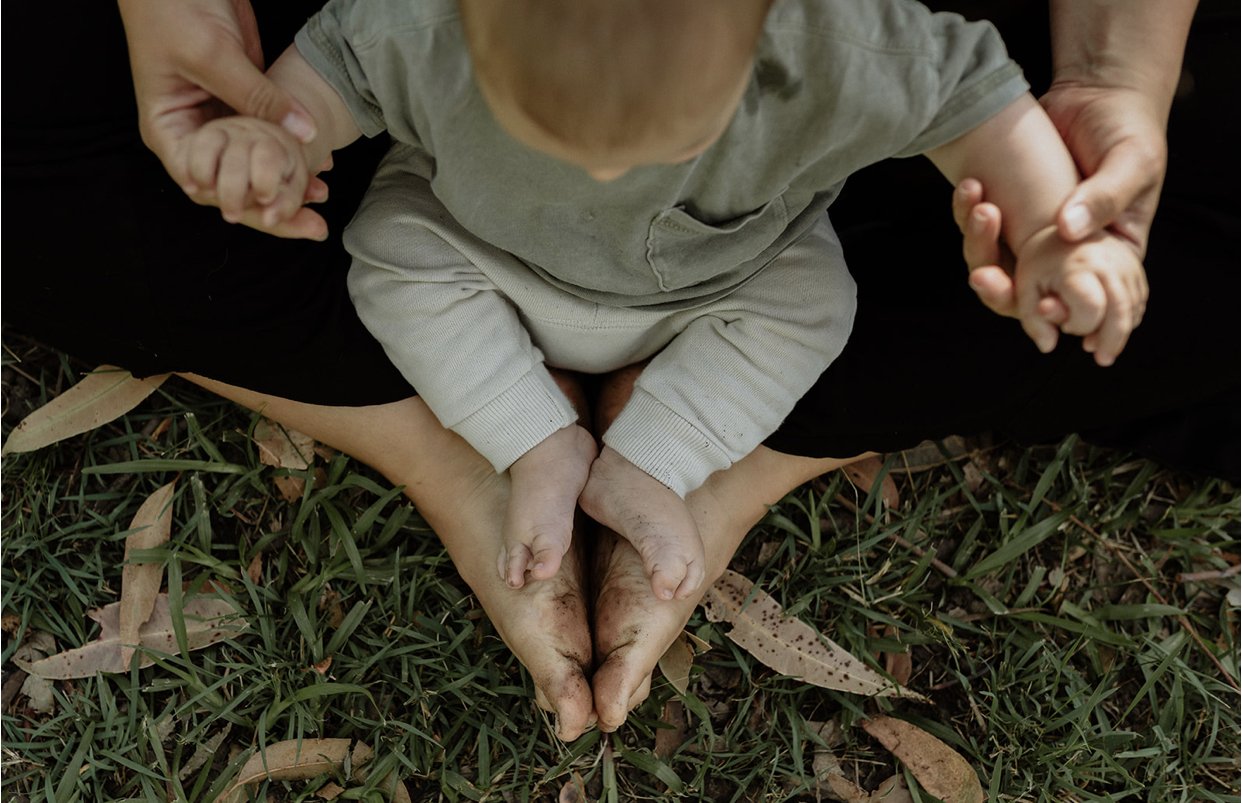
Postpartum · when sukha must lead
If pregnancy and birth ask us to dance between strength and softness,
postpartum asks us to rest inside softness first.
This is a threshold season.
The body has opened.
Hormones shift dramatically.
Sleep fragments.
Identity reorganises.
Yet this is often the moment when women are asked to “bounce back.”
But postpartum is not a time to thrive in loud ways. It is a time to be held. Here, sthira becomes very small and very precious:
consistent nourishment
gentle rhythms
dependable support
And sukha becomes essential:
rest without explanation
slowness without apology
being cared for, not only caring
Softness here is not indulgence. It is protection. It is how the nervous system repairs. It is how experience is slowly integrated. It is how safety is rebuilt after intensity. It is how possibility of making meaning is nourished.
Safety as the ground
In trauma-sensitive work, safety is not something we reach after doing enough. It is the ground from which everything else grows.
Sthira helps us stay connected. Sukha helps us feel safe enough to stay. Together, they allow the body to trust its own timing.
A closing reflection
If you find yourself unable to thrive right now, if strength feels far away, if softness feels necessary —nothing has gone wrong.
You may simply be in a season where sukha is leading.
And that, too, is wisdom.
This is not a failure of strength.It is a deep listening to what the body needs in order to heal.